
 +34 68 911 88 69
 +382 69 704 986
31 August 2026
Temporary residence, permanent residence, and citizenship: key differences
What is a residence permit?
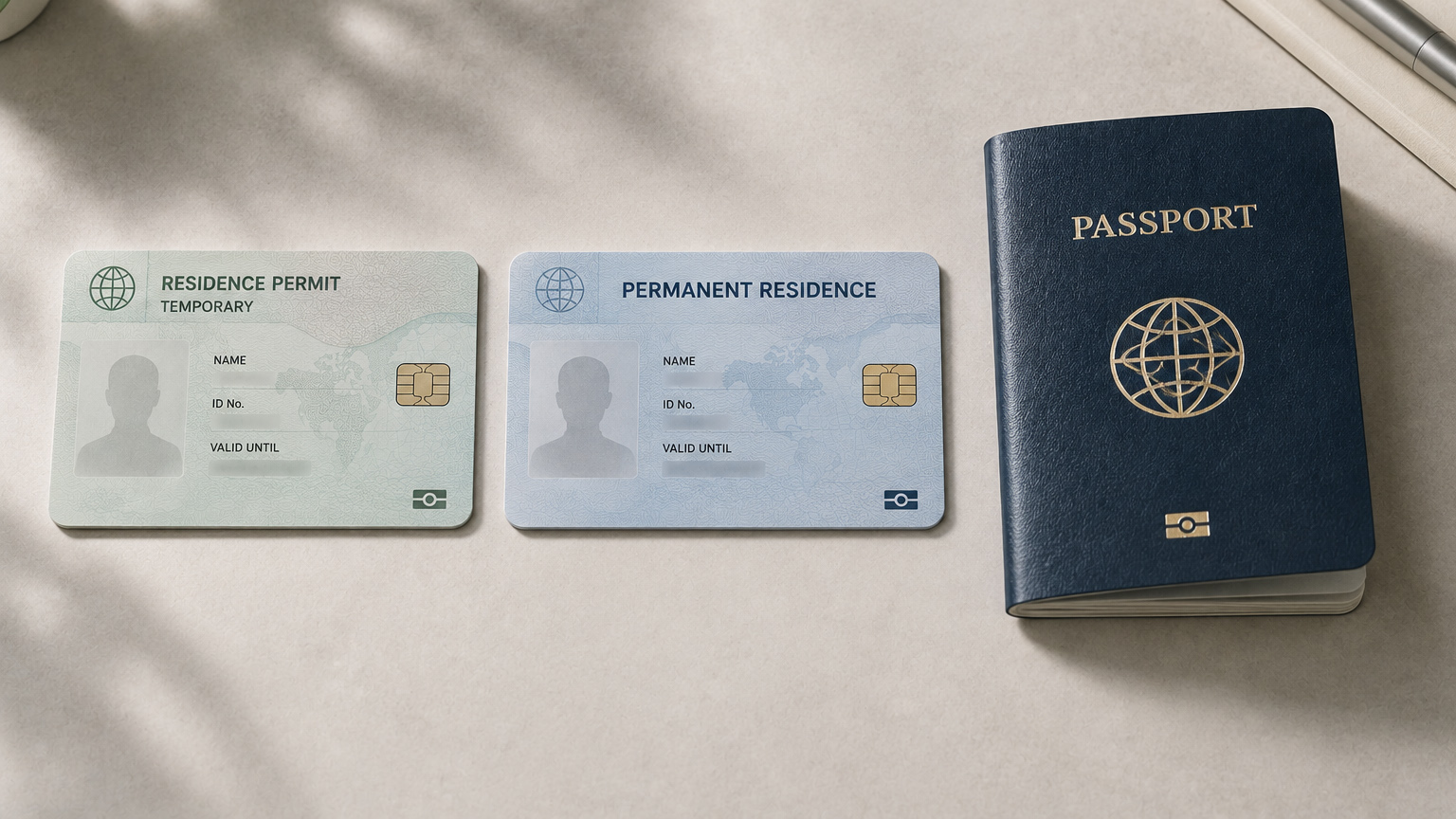
A residence permit allows a foreign national to live, study, work, and conduct business in a country. Typically, a residence permit is valid for 1 to 5 years and can be renewed. In rare cases, however, it can be issued for up to 10 years, as is the case with investment programs in Hungary and the UAE.
A residence permit can be obtained based on:
- Employment with a local company;
- University studies;
- Starting a business;
- Investment;
- Remote work;
- Family reunification with a resident or citizen of the country.
To maintain a residence permit in the long term, it must be renewed regularly by confirming that the grounds for continued stay in the country still exist. Usually, after 5 years of living with a residence permit, you can apply for permanent residency.

We provide comprehensive support throughout the residence permit application process
Submit a request to receive legal advice
Benefits of a residence permit
A residence permit allows legal residence in the country for more than 90 days and provides access to the following opportunities:
- Employment, starting a business, or entrepreneurial activity, subject to approval from local authorities;
- Enrolling children in kindergartens and schools;
- Studying at a college or university;
- Medical care, including potential participation in the state insurance system;
- Access to social care;
- Travel within the Schengen Area for holders of residence permits from Schengen countries.
Restrictions for temporary residents
In most countries, holders of temporary residence permits cannot:
- Change jobs without approval from the immigration authority;
- Receive unemployment benefits, housing subsidies, or targeted social assistance;
- Qualify for retirement pension, as these require a specific work history and years of contributions to the pension fund;
- Reside in the country indefinitely;
- Leave the country for an extended period (more than 6 months), though exceptions are usually made for residence permits obtained through investment.
Requirements for obtaining a temporary residence permit
To obtain a temporary residence permit, you must have a valid reason that can be documented. For example, if you are applying for a work permit, you need an employment contract. If you are applying for a family-based permit, you need proof of a family relationship with a resident or citizen of the country. Students must provide a certificate of enrollment from a university.
You must also demonstrate that you have sufficient funds to cover your intended stay; a bank statement can serve as proof of funds.
To prove that you have accommodations, you must provide a lease agreement or a property purchase contract in your name. You must also have medical insurance that covers all potential health-related risks; the policy must be valid for the entire duration of your intended stay. When applying for the permit, you must provide your international passport.
Is it possible to lose your temporary resident status, and if so, what are the reasons?
You can lose your permit if the reason you are staying in the country ends: for example, if your employment contract ends, your business activities stop, you are expelled from university, or your marriage ends.
Submitting fraudulent documents, violating the law, or posing a threat to national security will result in revocation of the permit. Exceeding permitted absence limits can also result in the loss of residency status.
For example, if you have a Cyprus residence permit, you cannot stay outside the country for more than 3 months. Staying outside the country for more than 3 months will result in the permit being revoked.

What is a permanent residence permit?
Permanent residence is a status that grants broader rights than temporary residence. It is indefinite and only requires the renewal of the physical ID card. With permanent residence status, you do not need to regularly re-verify the basis for your stay, such as proving ongoing employment or continued studies.
Permanent residents are eligible to apply for citizenship if they have met all legal requirements. Furthermore, in certain countries, such as Bulgaria, Serbia, and Poland, permanent residency is a prerequisite for citizenship.
The difference between permanent and temporary residency
Unlike a temporary residence permit, permanent residence status does not expire and does not require renewal. Permanent residents do not need to periodically prove that they have grounds to continue living in the country.
Permanent residence permits you to travel abroad and stay there for more than 6 months without losing your status. With a temporary residence permit, time spent outside the country is often limited to 3-6 months.
Permanent residence status allows you to change jobs or start a business freely without obtaining additional permits. A temporary residence permit restricts you to working for a single employer, and changing jobs requires obtaining a new permit.
Rights granted by permanent residence
Permanent residence allows you to live in the country indefinitely and enjoy many of the same rights as citizens:
- Leaving and re-entering the country without a visa;
- Getting a job, changing employers, starting a business, or engaging in entrepreneurial activities without additional permits;
- Accessing healthcare services;
- Studying at local educational institutions;
- Receiving social benefits;
- Purchasing real estate and movable property;
- Obtaining loans and mortgages from local banks;
- Initiating family reunification;
- Applying for citizenship in the future (in some countries, permanent residence is a prerequisite).
Restrictions on permanent residents
Permanent residents may travel abroad, but there are limits on the maximum duration of absence. For example, Cyprus and Portugal revoke status if a resident is absent for more than 2 years.
Permanent residence does not grant the right to vote in national elections. Additionally, permanent residents cannot hold positions in the civil service or diplomatic missions. Certain professions, such as judges, notaries, and lawyers, are also unavailable to them.
Are you interested in applying for a residence permit or dual citizenship?
Get a personalized consultation and a free assessment of your immigration options from a MIRSATORI specialist
Submit a request and get advice from an expert

Conditions for obtaining permanent residence after a temporary permit
The standard procedure involves several stages. First, you obtain a residence permit and live in the country for 3–5 years. After that, you can apply for permanent residency if you have integrated into local society. This entails having a job, housing, and a stable income. Knowledge of the national language is sometimes required as well.
There are also investment programs that allow you to obtain permanent residency immediately without a long waiting period or the need for integration. For example, in Malta, you can obtain permanent residency by purchasing real estate valued at EUR 375,000 or more.
Reasons for permanent residency revocation
Permanent residency status may be revoked due to prolonged absence from the country (more than 2 years in EU states). Engaging in activities that threaten national security or committing a serious or particularly grave crime can also lead to the loss of permanent residency. Providing false information or entering into a sham marriage during the application process can also result in revocation.
What is citizenship?
Citizenship signifies your affiliation with a specific state. It grants the right to state protection and the full scope of civil rights, while also entailing the fulfillment of obligations established by law.
Citizenship can be acquired by birth (if the country recognizes *jus soli*, or “right of the soil”), by descent, or through naturalization. Some countries, such as those in the Caribbean, offer citizenship-by-investment programs in which a passport is issued in exchange for a financial investment.
Holding citizenship of 2 countries is commonly referred to as dual citizenship, while holding citizenship of more than 2 countries is generally known as multiple citizenship.
If 2 countries mutually recognize a person’s status as a citizen of both states under a bilateral treaty or other legal arrangement, this is often described as dual citizenship. By contrast, if a person holds more than one citizenship but each country treats them solely as its own citizen, the situation is more accurately described as multiple or second citizenship, depending on the context and local legislation.
How citizenship differs from permanent and temporary residency
Temporary and permanent residency are statuses that allow you to legally reside in a specific country. However, citizenship guarantees full access to civil rights, including visa-free travel using that country’s passport.
You can lose temporary or permanent residency by leaving the country for an extended period. Losing citizenship requires significant grounds, such as posing a threat to national security.
Holders of temporary or permanent residence permits do not have access to consular assistance abroad from the country that issued their permit. Diplomatic protection is provided solely by the country of citizenship.

Full range of citizens’ rights
A national passport grants access to all civil, cultural, social, economic, and political freedoms guaranteed by the state constitution.
Key citizens’ rights include:
- The right to life, dignity, and an adequate standard of living;
- Personal liberty and the right to personal inviolability, which cannot be infringed upon without a court order;
- Inviolability of the home;
- Privacy of telephone conversations and personal correspondence;
- Freedom to express personal thoughts, words, views, and beliefs;
- The right to form public organizations and political parties and to hold peaceful assemblies;
- Ownership, disposal, and use of private property, including land;
- The right to engage in various types of business activities not prohibited by law;
- Free choice of profession and employment without coercion;
- The right to strike to protect social and economic interests;
- Access to free state healthcare, education, and social protection;
- Access to diplomatic protection abroad;
- Eligibility to hold positions in government organizations;
- The right to pass citizenship status on to children;
- For EU citizens, there is the right to reside indefinitely in any other EU country without special permits.
Citizen obligations
Although citizenship grants access to the full range of rights, it also imposes specific obligations that every passport holder must fulfill:
- Following the Constitution and laws and respecting state symbols;
- Respecting the rights and freedoms of others;
- Raising and caring for one’s children;
- Ensuring that children receive an education;
- Caring for one’s incapacitated parents (provided one is at least 18 years old and able to work);
- Completing secondary education;
- Preserving nature and historical and cultural heritage;
- Paying taxes and fees established by national legislation;
- Defending the state and performing military service.
How to obtain citizenship?
Citizenship can be obtained in various ways. The most common method worldwide is naturalization. This procedure allows one to become a citizen after several years of legal residence. For example, in Germany and France, one can obtain a passport after 5 years of residence with a residence permit. The naturalization period is 10 years in Vanuatu and 8 years in Hungary. In Bulgaria, one must hold permanent residence status for at least 5 years. Before applying for citizenship, applicants are usually required to pass a state language proficiency exam.
Obtaining a passport through marriage is often easier. Spouses of citizens typically face shorter residency requirements and are less frequently required to prove language proficiency. For example, obtaining a passport in Germany or Portugal requires at least 3 years of residence. However, the marriage must be genuine and involve cohabitation, rather than a sham marriage.
It is possible to obtain citizenship without meeting residency requirements or proving language proficiency through investment. A passport is issued in exchange for financial contributions to a country’s economic development. For instance, one can become a citizen of Vanuatu in as little as 2 months through investment. The required investment for the Vanuatu fund is at least USD 130,000 per applicant. Turkey offers several options, one of which involves investing a minimum of USD 400,000 in real estate that cannot be sold for 3 years. Similar programs exist in countries across the Caribbean and Africa.
Another method is based on the principle of jus soli (right of the soil), which allows any child born within a country’s territory to acquire its citizenship. Brazil is one such country, where conditions for foreign parents are simplified. They are eligible for a residence permit and can apply for a Brazilian passport after just 1 year. Argentina and Chile also observe jus soli; a child acquires citizenship by virtue of birth, and the parents can benefit from an easy path to legal status as well.

Which residency status is right for you?
The status you need depends on your goal in a specific country. In practice, this might look like the following:
- Relocating for work, study, business, or family reunification: temporary residence permit;
- Securing a “Plan B” option without a mandatory residency requirement: investor residence permit or citizenship;
- Living permanently without the need for regular status renewals: permanent residence permit;
- Having full access to civil rights requires citizenship;
- Holding a second passport and maximizing global opportunities: citizenship;
- Moving temporarily to get to know the country: temporary residence permit;
- Obtaining stable status with no risk of losing it: citizenship;
- Passing the status on to your children: citizenship.
There is no one-size-fits-all solution. To determine which status suits you best, you need to analyze your specific situation, goals, and financial capabilities.
Residency vs. tax residency: an important distinction
Residency is an official status granted by immigration authorities. A foreign national holding a temporary or permanent residence permit is considered a resident. However, obtaining temporary or permanent residency does not automatically obligate you to declare and pay taxes on your worldwide income in that country, nor does holding a second citizenship.
In most countries, the obligation to pay taxes on worldwide income arises only after acquiring tax residency status. This status is usually granted after living in the country for at least 183 days in one calendar year.
When determining your tax residency, your “center of vital interests” may also be taken into account. If you split your time between 2 countries, your center of vital interests is considered to be wherever your family lives and wherever your job, business, or other primary source of income is located.
You may incur tax obligations in both countries if you live in 2 countries. In such cases, a double taxation avoidance agreement may apply if one exists between the 2 nations. These agreements prevent the same income from being taxed twice.
Typically, countries do not require their citizens to report foreign accounts to tax authorities. The United States is an exception; its citizens must report foreign financial accounts regardless of their country of residence.
Countries where it is easier to obtain a residence permit, permanent residency, or citizenship
One straightforward option is the residence permit designed for digital nomads. This status is available in the UAE, Portugal, Spain, Hungary, and Greece. You do not need to make significant investments in the local economy; an employment contract with a foreign employer and proof of regular income suffice. The minimum income requirements are EUR 3,680 in Portugal, EUR 2,442 in Spain, and USD 3,500 in the UAE.
In Serbia and Montenegro, it is easy to obtain a residence permit by establishing a company. The minimum authorized capital for a firm is just EUR 1.
Obtaining residency status through financial investment is also relatively simple. For example, Cyprus requires an investment of at least EUR 300,000, and in Malta, you can purchase property starting at EUR 375,000. Both countries offer permanent residency options. Portugal offers a “Golden Visa” for investments between EUR 250,000 and EUR 500,000. Turkey offers a residence permit in exchange for purchasing real estate for at least USD 200,000.
Currently, the easiest way to obtain citizenship is through countries that offer investment programs. These include Turkey, Caribbean nations, São Tomé and Príncipe, Sierra Leone, and Nauru. For example, São Tomé and Príncipe require a USD 90,000 investment and a 2-month waiting period. In Sierra Leone, citizenship can be obtained in 3 months for USD 140,000.
FAQ
Ask a questionCan citizenship be obtained directly, without first obtaining a residence permit?
Yes. In countries such as Sierra Leone, São Tomé and Príncipe, and Nauru, you can obtain citizenship through investment, bypassing the temporary and permanent residence permit stages.
Do I have to renounce my original citizenship?
Renunciation is not required when obtaining temporary or permanent residence permits. However, there are nuances when acquiring citizenship in another country. If the new country recognizes multiple citizenships, you can obtain a new passport without giving up your original one. You must also consider the immigration laws of your home country.
Can I live in a country my whole life with just a residence permit?
Yes, if you don’t plan to apply for permanent residence or a passport from the other country. However, you must have a valid reason to renew your residence permit, such as maintaining your investment.
Which option is best for a family with children?
It is best to choose programs that allow the entire family to be included in a single application. Examples include Spain’s digital nomad program and residence-by-investment programs in Greece and Cyprus. If you want to secure immediate citizenship and broader opportunities for yourself and your children, consider Citizenship by Investment (CBI) programs.
What happens when you change your country of residence?
If you move to another country, your status (temporary or permanent residency or citizenship), living conditions, working conditions, and access to social services will change. Spending at least 6 months in the new location will result in a change of tax residency. Consequently, you will be required to pay taxes in the new country on your worldwide income.




The latest news, helpful tips, and insider information — all on our social media channels. Join Mirsatori’s communities and channels:


Fill out the form to schedule a meeting in the office or online

 +971 58 94 43 591
